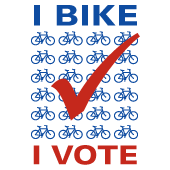
My letter to Oklahoma Representative James Lankford, a member of the House transportation committee, asking for his support of biking and pedestrian funding.
*(I should add that the first three paragraphs are mine, the rest is the generic letter I sent through Rails-to-Trails. I also sent letters via LAB and Alliance for Biking and Walking and other orgs fighting for our rights. Watching the vote now – SL)
Dear Representative Lankford:
I have written to you in the past asking for your support of bicycling, but never have the circumstances been more dire.
As a country we may not realize it yet, but biking will be an important mode of transportation in the future. To many of us it already is. I know people who can’t afford to own a car or two cars for couples and use a bike (or walk) to get to work, school, shop, etc. Of course I also know people who ride for recreation and enjoyment.
As you may recall, Oklahoma City Mayor Cornett challenged Oklahoma City residents to exercise and lose weight – and they did, over one million pounds. Many did so by biking. As a country we need to do everything we can to encourage people to bike, walk and focus on their health – certainly not reduce funding to the very programs that provide for these activities.
I ask you, as a member of the House Transportation and Infrastructure Committee, to vote for the Petri/Johnson/Lipinski amendment that will restore dedicated funding to the Transportation Enhancements (TE) program, among other important fixes, in reauthorization markup.
In particular, I am deeply upset that the draft bill eliminates the rail-trail category. Rail-trails do tremendous good for everyone: commuters, children learning to ride a bike, and small towns looking to boost their tourism and attract families. We all desperately need–and deserve–more such opportunities.
I look forward to hearing of your efforts to stand with Reps. Petri, Johnson and Lipinski by voting for this amendment to restore dedicated funding to the TE and Safe Routes to School programs.
Sincerely,
*Update: Unfortunately, the amendment failed by two votes. It isn’t over but this was a set-back. Rep. Lankford didn’t vote for it – no surprise. Two Republicans on the Committee voted yes, all Democrats did. Thanks to everyone for all efforts made in support of biking and pedestrian programs. More will be needed, and as I learn of future votes, etc. I’ll try to pass them on here. –Susan
If you care about bicycling, or walking in your community for that matter, you need to take action – NOW.
Dedicated funding for bicycling and walking programs is eliminated completely in the new Transportation funding bill, American Energy and Infrastructure Jobs Act, currently in the House Transportation and Infrastructure Committee.
The time to act is now:
If one of your representatives is on the Committee (Oklahoma Representative James Lankford is) please contact them immediately. An easy way to do that has been provided here by the League of American Bicyclists.
To find out if your congressman is on the transportation committee go here and follow the process using your zip code. Even if your rep is not on the committee you should still contact them to voice your support.
The committee votes tomorrow, Thursday February 2, 2012. Yep, on Groundhog Day. That’s not a coincidence is it.
From Instructables.com is a handy step-by-step guide on how to restore an old bicycle.
The rebuild guide includes a list of tools and equipment you’ll need and pictures of each step.
I’ve never been lucky enough to find a discarded bike in the trash or a cheap one at a garage sale but I know people who have and they end up with a nice machine at very little cost.
This is an excerpt, I encourage you to read the entire article.
If it hasn’t yet been pounded into your head that biking is good for you and good for society, you’re either not reading enough or incredibly stubborn. The evidence for biking abounds: It’s good for you, without being too high impact (unless that impact is a car). More bikers make cities more pleasant to live in.
And instead of spending a lot of money on fuel, bikers put that cash to better use, like buying more food to quell an enormous appetite after a long bike ride to work. A new infographic does a great job of making the case for biking in terms of dollars, health, and liveability. If you’re not convinced after this, you may never be.
If biking does such wonders, why aren’t the benefits more apparent? Shouldn’t we be a nation of lithe and fit bikers? We’re not because almost no one is biking. Just .6% of all trips are taken by bike; 90% are taken by car. No one even considers taking their bike down the street to the store, let alone to work. Increase that tiny sliver, though, and the societal benefits might end up being enormous.
In a study about what would happen if people in 11 midwestern cities (not some hippie city like Portland) spent four months a year doing half their errands by bikes, the results were staggering. In terms of health costs alone, the switch would result in $3.8 billion in savings, which is to say nothing of the resulting $3.5 billion worth of clean air. But forget money; it would also save lives. The resulting lack of car accidents would prevent enough accidents and health problems to keep 1,100 people alive over the course of a year.
But let’s be less heavy–literally. Biking is really good exercise and it makes you skinnier. The average person who starts biking to work loses 13 pounds over the next year, an exceptional health benefit. And you can see this result by comparing biking cities with nonbiking cities.
Surely, there are some dangerous correlation-equals-causation problems with these comparative stats. There is a lot about life in Holland and Germany that makes their populations less obese, not just how much they’re biking. But there is a more clear example. Portland, Oregon–yes, the aforementioned hippie city, but stick with me–has poured money into making the city a more pleasant place to bike, in an effort to get more people cycling. Now, 6% of its commuters bike.
It’s not because the city thinks it will be more fun with more bikers, it’s because it wants to realize the cost savings associated with a biking population. And this year, the city will save about $75 million. By 2040, that number will be $400 million. All for what it costs to paint some bike lanes.
For the Love of Bikes Blog (2009 – 2021) is licensed under a Creative Commons Attribution-NonCommercial-NoDerivatives 4.0 International License. Based on a work at www.loveofbikes.com.